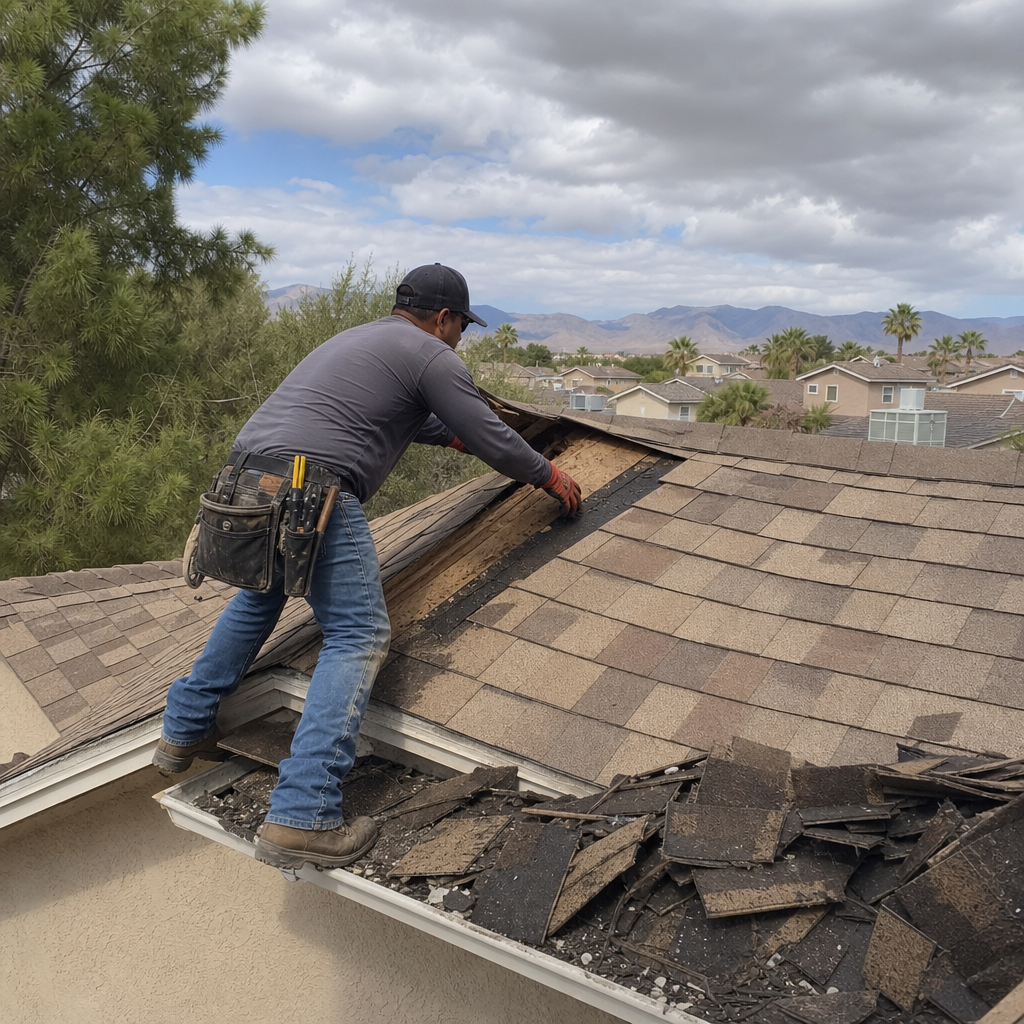
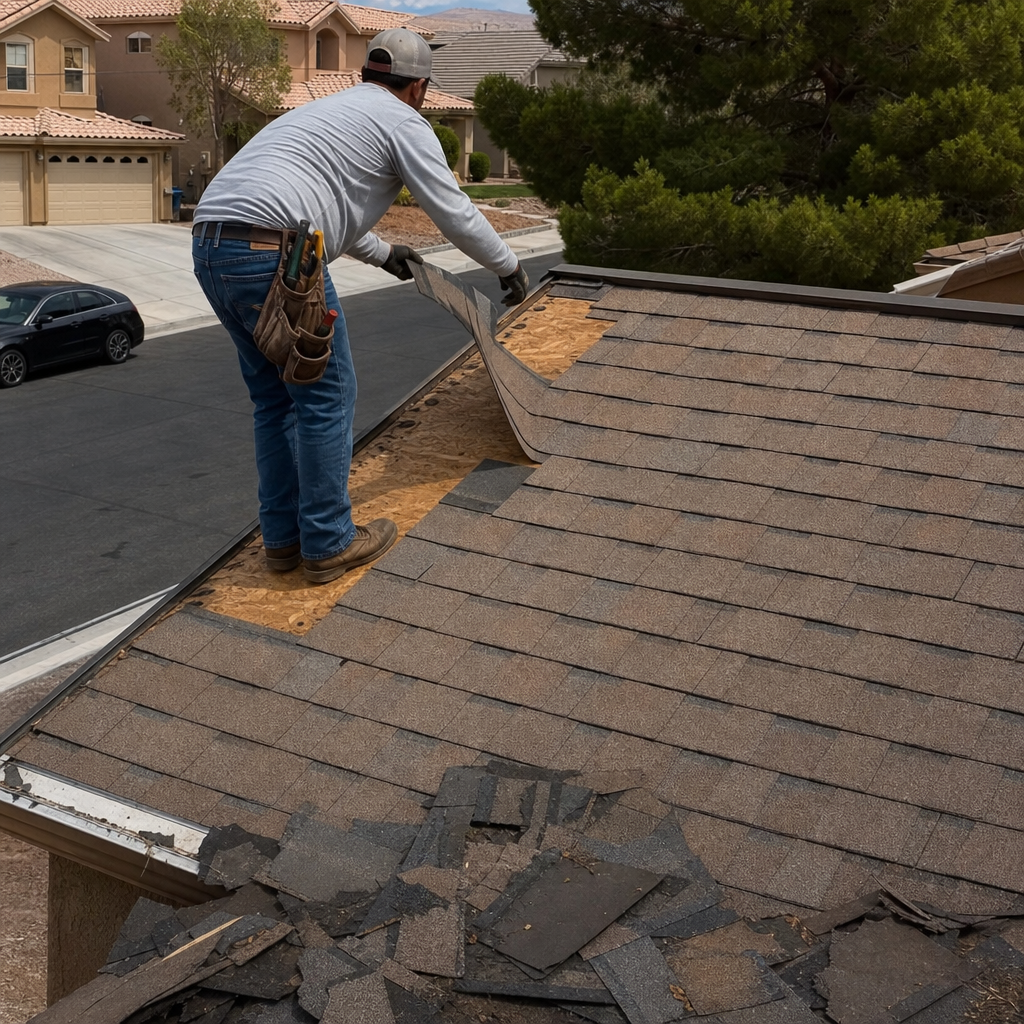
Emergency & Storm Damage in Enterprise, NV
If your roof took a hit from last night’s monsoon — or you’ve just noticed water pooling inside after what looked like a minor storm — Enterprise homeowners face a problem that goes beyond the leak itself. In HOA-governed communities like Mountain’s Edge, Silverado Ranch, and Southern Highlands, an emergency repair done with the wrong tile color or profile can trigger an Architectural Review Board violation notice before the drywall even dries. We’re Absolute Roofing & Repair Las Vegas, and our Emergency & Storm Damage response is built specifically around that dual reality: stop the water, match the tile, document everything for your insurer — in that order. Call us now at (725) 444-5513.
Why Absolute Roofing & Repair Las Vegas Is Enterprise’s Preferred Emergency & Storm Damage Company
Serving Enterprise for a decade means we know the builders who put up Mountain’s Edge and Silverado Ranch, the concrete tile profiles their ARBs still require, and the exact failure patterns that hit these mid-2000s roofs every monsoon season. That’s not marketing copy — it’s the difference between a repair that closes the claim and one that opens a violation letter.
341 verified reviews averaging 4.9 out of 5 stars. Those numbers come from homeowners in communities like these, people who needed an honest assessment after a storm and got one. William Turner isn’t the salesperson who hands your job to a crew you’ve never met. He’s the lead technician. He’s on the roof. That accountability runs from the first call to the final inspection, and Enterprise homeowners have noticed.
When a monsoon cell rolls up Saint Rose Parkway or cuts across South Decatur Boulevard at 10 p.m., we don’t tell you to wait until morning. Emergency tarp response is a core part of what we do, not a favor we squeeze in. We stage quickly, we respect HOA quiet-hours restrictions where they apply, and we document tile profiles on the first visit so the replacement order is ARB-correct from day one.
Our Emergency & Storm Damage Services in Enterprise
Storm Damage Repair
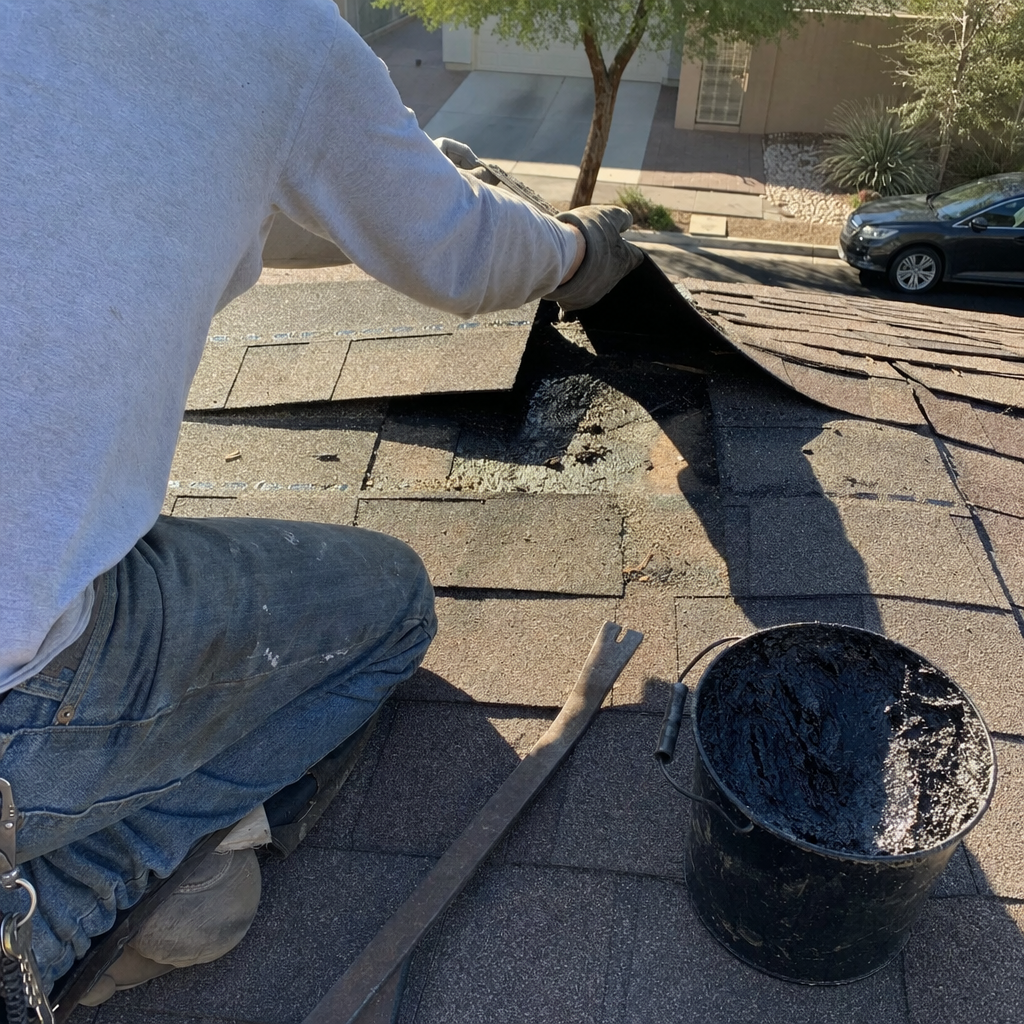
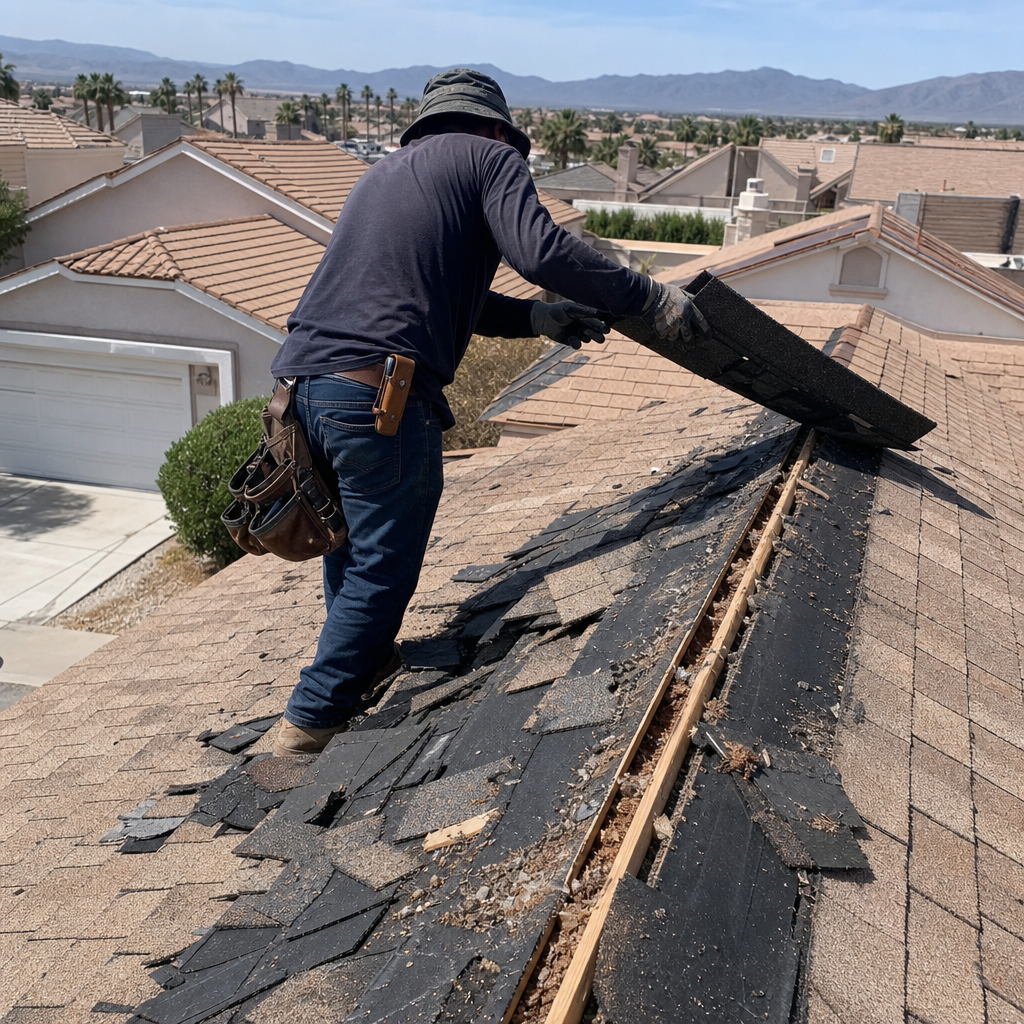
Enterprise’s concrete tile roofs are durable on the surface, but the #30 felt or early synthetic underlayment installed during the 2002–2011 building boom is now at or past its serviceable life. A monsoon event that looks minor — a few cracked tiles along a valley flashing — can expose an underlayment that’s already oxidized to near-paper thickness across a much wider area. We assess the full damage picture, not just the visible breakage, and we carry GAF, CertainTeed, Owens Corning, IKO, Atlas, Tamko, and Boral materials so repairs are done with product that meets your HOA’s approved specifications.

Emergency Tarp Services
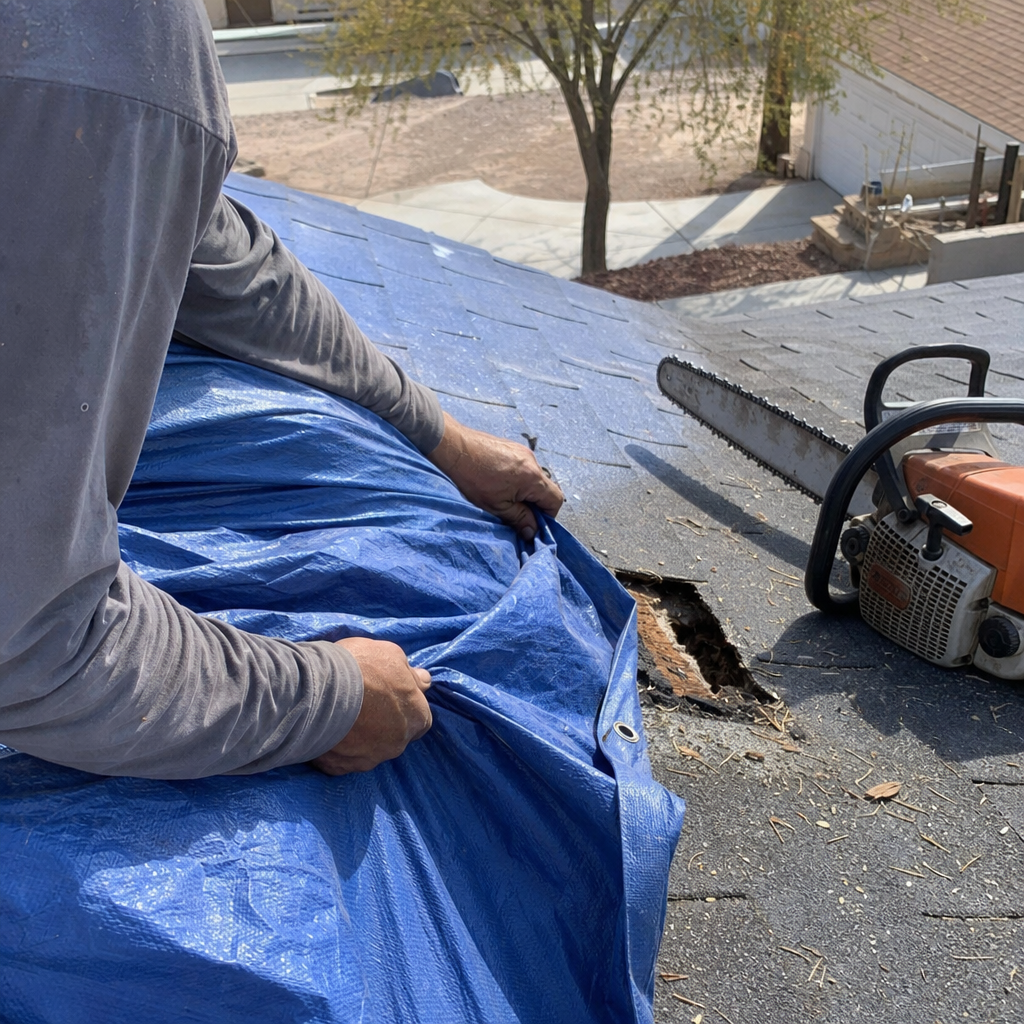
A properly deployed emergency tarp stops interior water intrusion within hours of a storm event and creates a documented protection baseline for your insurance adjuster. In Enterprise’s HOA communities, tarp deployment comes with an extra layer of planning: The Core at Southern Highlands and similar neighborhoods enforce quiet-hours and staging restrictions that limit when power equipment and service vehicles can operate after an evening storm. We know those rules, and we plan tarp deployment around them — because a tarp installed at the wrong hour can generate a noise complaint on top of everything else.
After a monsoon cell tracked up Saint Rose Parkway last August, our crew reached a Silverado Ranch homeowner whose Boral concrete tile roof showed zero visible surface cracking from the street — yet water was pooling inside a master closet within hours of the storm. We pulled six field tiles and found the original #30 felt underlayment had oxidized to a paper-thin sheet that split the moment standing water applied pressure. We emergency-tarped the 400-square-foot affected section that evening and documented the tile profile and ARB color designation so the replacement concrete tile we ordered matched the community’s approved sand-castle blend exactly, keeping the homeowner clear of any violation notice during the insurance claim process.

Insurance Claims Assistance
Enterprise homeowners filing storm-damage claims face a complication most adjusters don’t anticipate upfront: HOA tile-matching requirements often push the actual material cost above the adjuster’s initial estimate. A replacement tile that meets Mountain’s Edge’s ARB specification may cost more per square than the adjuster’s line item allows. We document everything — tile profile, ARB color designation, manufacturer batch compatibility — and provide the supplemental documentation your insurer needs to close the gap. We don’t leave you to fight that conversation alone.

Wind & Hail Damage
Enterprise’s position in the southern Las Vegas Valley means it catches the full force of desert monsoon winds, which frequently gust above 60 mph along corridors near the Airport Connector and Hidden Well Road. Wind lifts valley flashing, separates ridge caps, and dislodges field tiles — damage that’s easy to miss from the street but causes serious interior water intrusion with the next rain event. Hail is less frequent here than in mountain-adjacent markets, but when it does fall during a convective storm, it pits and fractures concrete tile in ways that compromise the interlocking seal between courses. We inspect for both on every post-storm visit.

What happens when you call
- 1
A real person answersNo phone trees — you reach a local pro.
- 2
You get an upfront price rangeHonest numbers before anyone is dispatched.
- 3
A background-checked tech heads outLicensed & insured, dispatched right away.
- 4
You approve before work beginsNothing starts until you say go.
The HOA Compliance Reality in Enterprise — Why It Matters From the First Call
Enterprise is almost entirely a product of the mid-2000s Las Vegas housing boom. Mountain’s Edge, Silverado Ranch, and Southern Highlands were mass-developed between roughly 2002 and 2011, meaning the community’s concrete tile roofs share nearly identical underlayment ages. That underlayment, punished by Mojave UV and 110°F+ thermal cycling, is now failing in synchronized waves — block by block, cul-de-sac by cul-de-sac. In Mountain’s Edge, we regularly document entire streets of the same builder’s product, same install year, same underlayment batch, failing within the same 18-month window. One homeowner calls after a monsoon leak. Their neighbor two doors down is next. That pattern is predictable, and knowing it shapes how we approach every Enterprise job.
What makes Enterprise uniquely complicated — and where contractors unfamiliar with this community cause real problems — is that every one of those HOA-governed communities mandates color- and profile-matched concrete tile approved by the Architectural Review Board. An emergency repair that uses a non-approved tile color or profile doesn’t just look wrong. It generates a violation notice. The homeowner is now managing storm damage, an open insurance claim, and an HOA compliance deadline simultaneously. Because entire cul-de-sacs in Mountain’s Edge were roofed with the same builder-specified Boral or CertainTeed concrete tile batch in the same year, sourcing a true color match is still achievable — but only if the contractor knows which profiles each community’s ARB has pre-approved before they place the material order.
Trusted Brands We Service in Enterprise
We carry active inventory across seven manufacturer lines — GAF, CertainTeed, Owens Corning, IKO, Atlas, Tamko, and Boral — because Enterprise’s HOA communities don’t give you the flexibility to substitute whatever happens to be in stock. Boral and CertainTeed concrete tile profiles appear frequently in Mountain’s Edge and Silverado Ranch ARB specifications, and having those lines immediately available means we can cross-reference approved color designations on the first visit rather than delaying your tarp-to-repair timeline while we source material. Seven manufacturers means the recommendation fits your roof and your community’s standards, not just our supply chain.
Common Emergency & Storm Damage Problems We See in Enterprise Homes
- Underlayment failure hidden beneath intact-looking tile: Enterprise’s 2000s-era concrete tile roofs frequently present with no visible surface damage after a monsoon, yet the #30 felt underlayment beneath has oxidized to near-failure from years of 110°F thermal cycling. By the time water reaches the interior ceiling, the compromised zone is often far larger than the entry point suggests.
- Valley and parapet flashing splits causing interior flooding: Extreme thermal expansion and contraction along metal flashings in Enterprise’s Mojave climate causes micro-fractures that widen gradually — then fail completely the first time a late-summer monsoon dumps an inch of rain in thirty minutes. What looks like a localized flashing repair often reveals failed underlayment in the surrounding field.
- Wind-lifted ridge caps and displaced field tiles: Monsoon wind events along corridors near South Decatur Boulevard and the Airport Connector regularly dislodge concrete ridge caps and shift field tiles out of their interlocking position. The tile doesn’t break — it just sits slightly wrong — and the first significant rain proves it.
- HOA violation notices following non-compliant emergency repairs: Homeowners who call the first available contractor after a storm sometimes receive an ARB violation letter weeks later because the replacement tile color or profile wasn’t on the community’s approved list for Southern Highlands or Mountain’s Edge. Fixing the leak is half the job. The other half is keeping the homeowner out of an HOA dispute.
Pricing for Emergency & Storm Damage in Enterprise, NV
Emergency and storm-damage work in Enterprise covers a wide range of scopes, so here are real market figures for what homeowners in the 89139 zip code typically encounter:
- Emergency tarp deployment (up to 400 sq ft): $350–$600
- Localized concrete tile storm repair (flashing split, 5–10 tiles, standard underlayment patch): $450–$900
- Partial underlayment replacement with tile re-set (100–300 sq ft): $1,200–$2,800
- Full-section underlayment replacement — common when monsoon reveals widespread #30 felt failure: $3,500–$7,500 depending on scope and tile re-use
- Insurance-assisted full roof underlayment replacement: $8,000–$18,000 for typical Enterprise tract-home square footage, subject to adjuster settlement
ARB-specified tile sourcing can add 10–20% to material costs compared to a non-HOA repair, because approved profiles and color designations sometimes carry a premium over standard stock. We build that into your written estimate upfront. Call (725) 444-5513 — the estimate is free, and we’ll tell you exactly where your job falls in these ranges before any work starts.
We Also Serve Cities Near Enterprise
Our emergency and storm-damage response covers the full southern Las Vegas Valley. Beyond Enterprise, we regularly serve homeowners in Spring Valley, Paradise, and Summerlin South — communities that share similar monsoon exposure and, in many cases, the same mid-2000s concrete tile housing stock. If your roof took storm damage anywhere in this corridor, call us at (725) 444-5513.
Serving Enterprise, NV — Our Local Coverage Area
We’re based in the Enterprise area and know this community well. Use the map below to see our service coverage — if you’re nearby, we can almost certainly help.
FAQs — Emergency & Storm Damage in Enterprise
The first step is to get the ARB’s specific citation in writing — the violation notice should reference the approved profile and color designation your repair must match. We can cross-reference that specification against the manufacturer’s current production run (Boral and CertainTeed are the most common in Mountain’s Edge) and source a compliant replacement tile. If a previous contractor used a non-approved color, we document the discrepancy, order the correct material, and coordinate a redo that satisfies the ARB requirement. This situation is fixable, but it needs to be addressed before the HOA escalates to fines. Call (725) 444-5513 and have the violation notice handy when you call.
Surface appearance tells you almost nothing about underlayment condition in Enterprise’s 2000s-era roofs. The concrete tile itself is highly durable — the failure point is the #30 felt or early synthetic underlayment underneath, which degrades from UV and thermal cycling without cracking the tile above it. Signs of underlayment failure include interior water staining after a storm, moisture in attic insulation with no obvious tile damage, or a musty smell in upper-floor rooms after rain. The only reliable assessment is a physical inspection — we lift field tiles in representative areas and check the underlayment directly. Don’t wait for a second storm to confirm what the first one started. Call (725) 444-5513 for a same-visit inspection.
Yes — and this is a real scheduling constraint we plan around specifically in The Core at Southern Highlands and similar communities. We stage tarp deployment to avoid power equipment during restricted hours, and we coordinate with the community’s rules on service vehicle parking before we arrive. In practice, this sometimes means a two-phase response: a lightweight manual tarp secured at the peak of quiet hours, followed by a proper mechanical tie-down once restrictions lift. The interior stays dry either way. Call (725) 444-5513 and tell us the community name — we’ll confirm the current HOA restriction window before we dispatch.
The adjuster’s initial estimate is typically based on a standard replacement tile at market cost — it rarely accounts for the premium attached to an ARB-specified Boral or CertainTeed profile in a community like Mountain’s Edge or Southern Highlands. The gap is real and it’s common. We document the ARB specification, pull the manufacturer’s current pricing for the approved profile, and prepare a written supplement that explains the cost differential to your adjuster in terms they can approve. Most carriers accept a well-documented supplement. We’ve walked Enterprise homeowners through this process many times, and the documentation we provide on the first visit is built around making that supplement as clean as possible. Call (725) 444-5513 before you sign anything with your insurer.
It depends on the underlayment beneath those cracked tiles — and in Enterprise, that answer is rarely “fine.” Valley flashings take the highest concentrated water load on a concrete tile roof, and if the surrounding underlayment has been thermally cycling for 15-plus years, a cracked valley tile is often the visible symptom of a much wider failure zone. A localized tile and flashing repair runs $450–$900 in Enterprise’s market. If we pull the tile and find compromised underlayment extending beyond the flashing, the scope expands — but we’ll document exactly what we find before we quote any additional work. Don’t let a valley crack sit through the next storm. Call (725) 444-5513 for a same-week inspection.
Ready to Protect Your Enterprise Roof?
Whether last night’s monsoon left a visible mess or you’ve got that uneasy feeling about a roof that’s been through fifteen Enterprise summers without an underlayment inspection — don’t let it go another storm cycle. William Turner will be on your roof personally, not a subcontractor, not a crew you’ve never met. Ten years of concrete tile work in this market, 341 homeowners who’ve trusted us with their biggest asset, and a 4.9-star track record that reflects what happens when the person accountable for the work is the person doing it. Call (725) 444-5513 today for a free estimate. We’ll tell you exactly what your roof needs, what it’ll cost, and how to keep your HOA satisfied from the first tarp to the final tile.
Reviewed by William Turner, Owner & Lead Technician at Absolute Roofing & Repair Las Vegas, serving Enterprise, NV since 2015.