Emergency & Storm Damage in Spring Valley, NV
When a monsoon storm tears through Spring Valley’s 89103 zip code and you’re staring at a blown seam on a rear flat section or cracked mortar ridgecaps letting water into your attic, the clock is already running. Absolute Roofing & Repair Las Vegas responds to Spring Valley emergencies the same day — and unlike a lot of crews dispatched after a storm, William Turner shows up personally. Call us now at (725) 444-5513 — free estimates, upfront pricing, no runaround.
Why Absolute Roofing & Repair Las Vegas Is Spring Valley’s Preferred Emergency & Storm Damage Company
Spring Valley homeowners have trusted us with their roofs for a decade, and the 341 verified reviews averaging 4.9 out of 5 stars aren’t from across the metro — a significant share are from residents along West Flamingo Road, the Buffalo Ranch corridor, and the Canyon Gate community who called us during or after a monsoon event. That track record exists because William Turner leads every job himself as both owner and lead technician. You don’t get a salesperson at the estimate and a stranger on the roof — you get William from the first call through the final inspection. That accountability is exactly what Spring Valley homeowners dealing with an emergency need, and it’s what separates a company built to handle crisis calls from one that simply advertises them. Our Emergency & Storm Damage team is structured specifically to mobilize fast — not reassigned from another division when storms hit.
We’ve served Spring Valley long enough to know what the housing stock does under pressure. That’s not a marketing line — it’s the reason we carry pre-sourced legacy tile inventory and why our emergency tarps go on rated for 150°F surface temperatures, not the hardware-store rolls that fail within a week in a Mojave summer.
Our Emergency & Storm Damage Services in Spring Valley
Storm Damage Repair
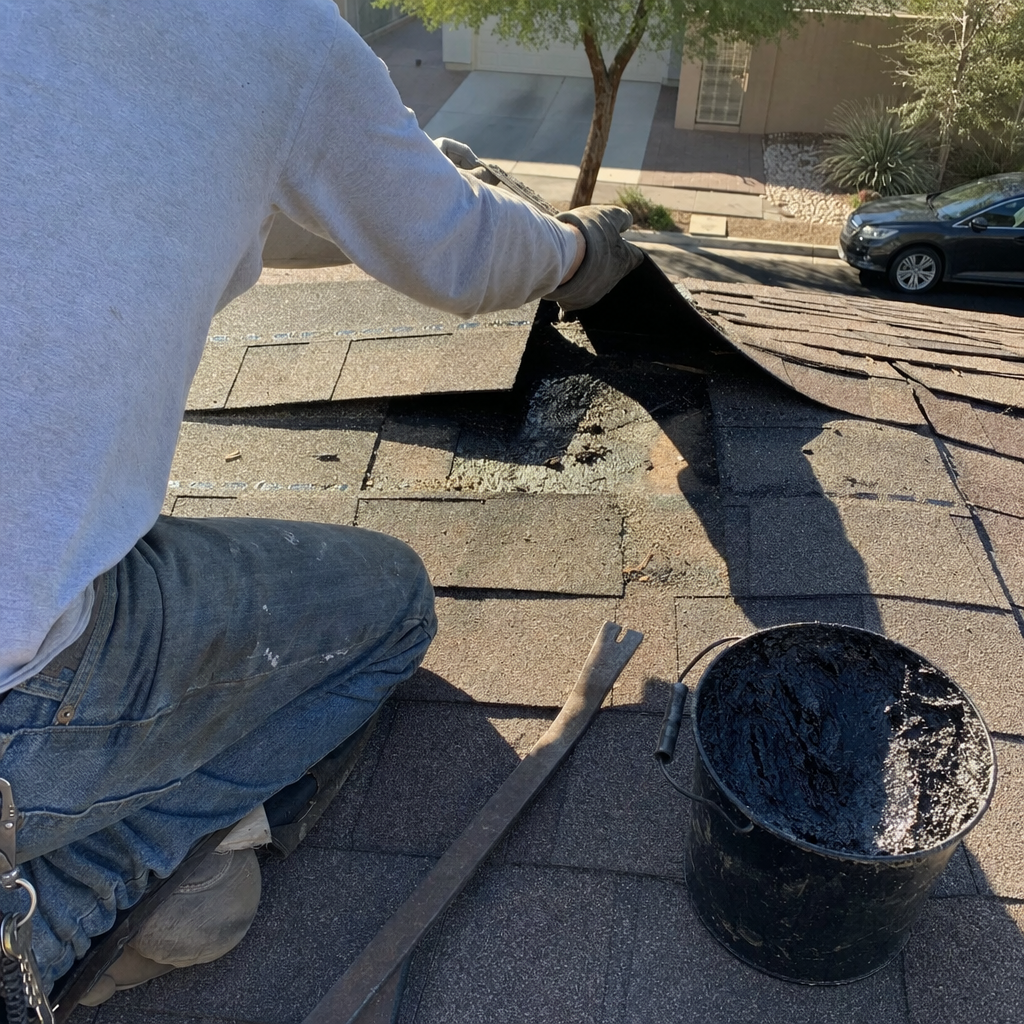
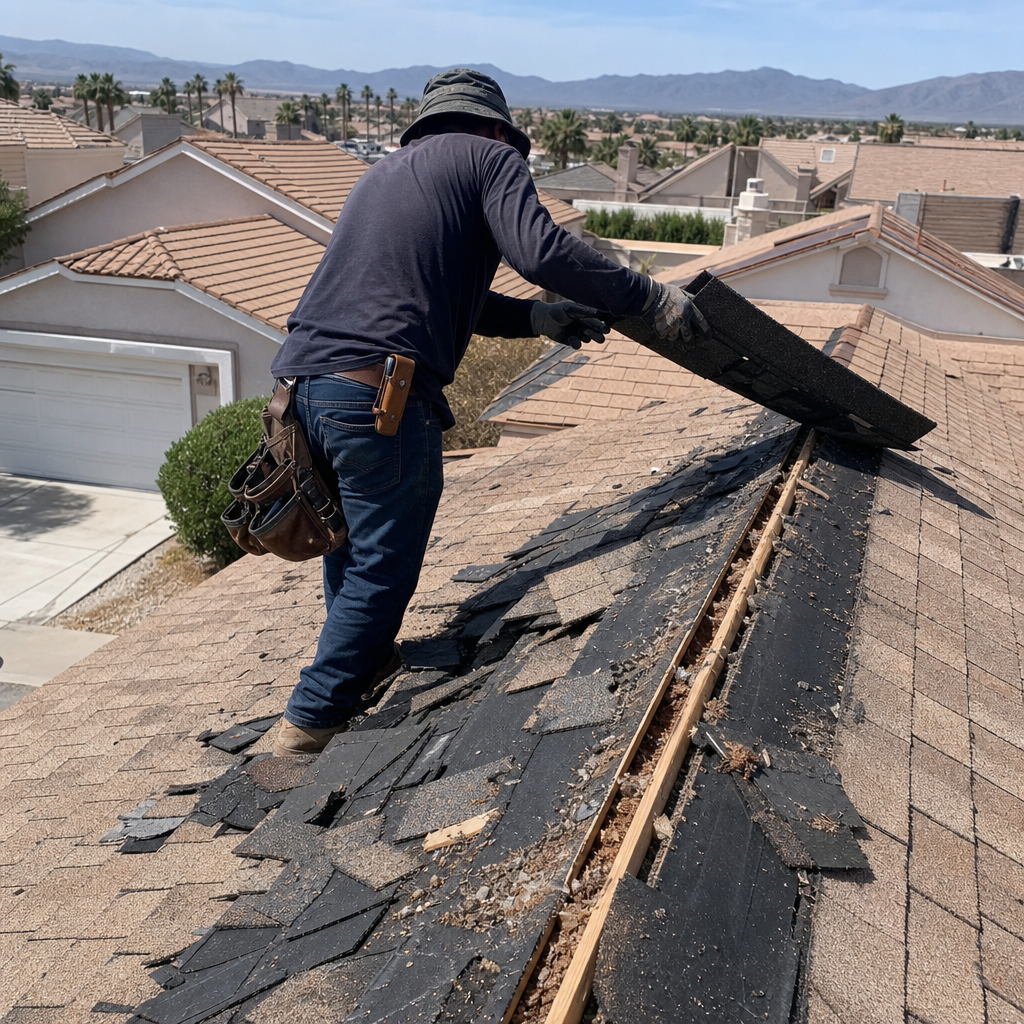
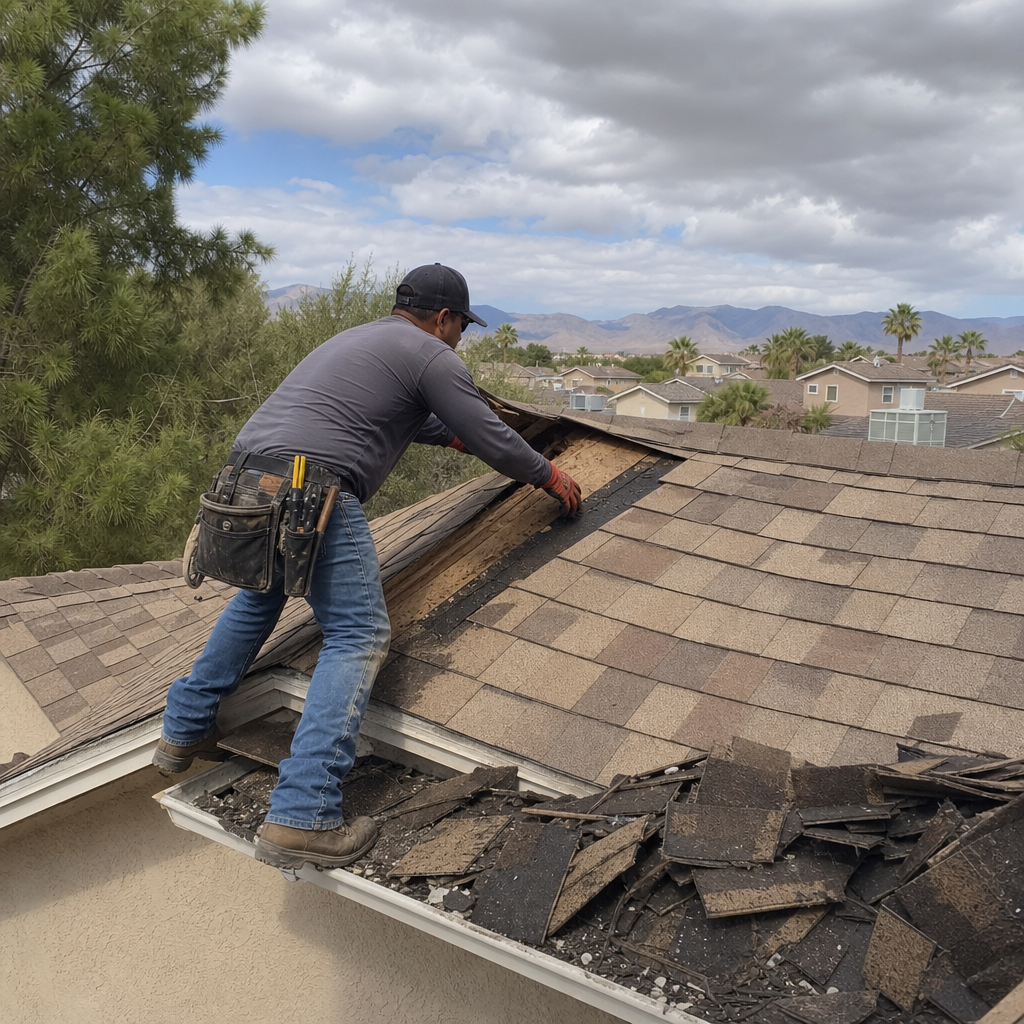
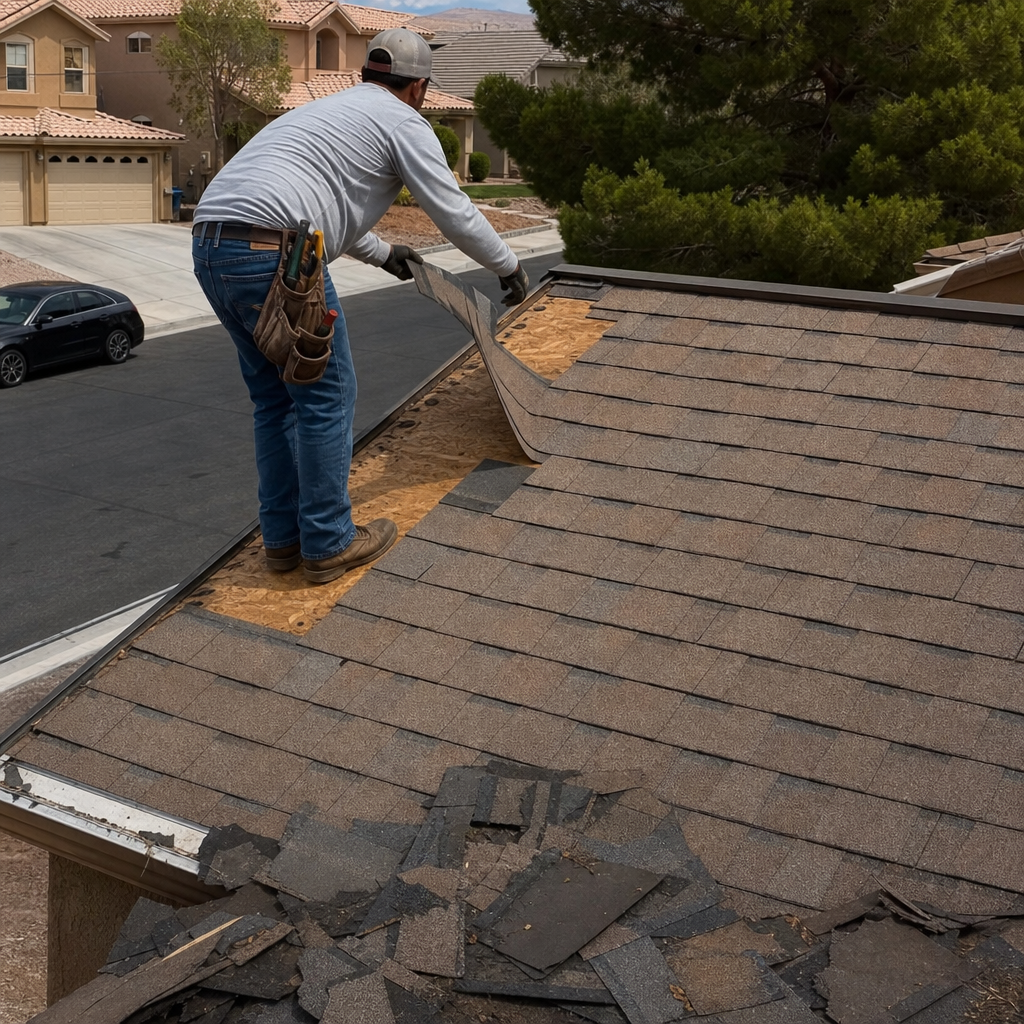
The bulk of storm damage calls we receive from Spring Valley involve the same failure pattern: years of UV embrittlement on modified-bitumen or built-up membrane flat sections — baked brittle under rooftop surface temperatures that regularly exceed 150°F at our 2,000-foot desert elevation — exposed by the first hard monsoon rain of the season. We assess and repair both the membrane and the underlying wood decking when it’s compromised, using GAF, CertainTeed, Owens Corning, IKO, Atlas, Tamko, and Boral materials selected for fit, not for what’s easiest to source. On pitched tile sections, we document cracked and displaced tiles, test mortar ridgecaps, and replace matching profiles — including discontinued 1980s and 1990s concrete tile molds where HOAs require it.

Emergency Tarp Service
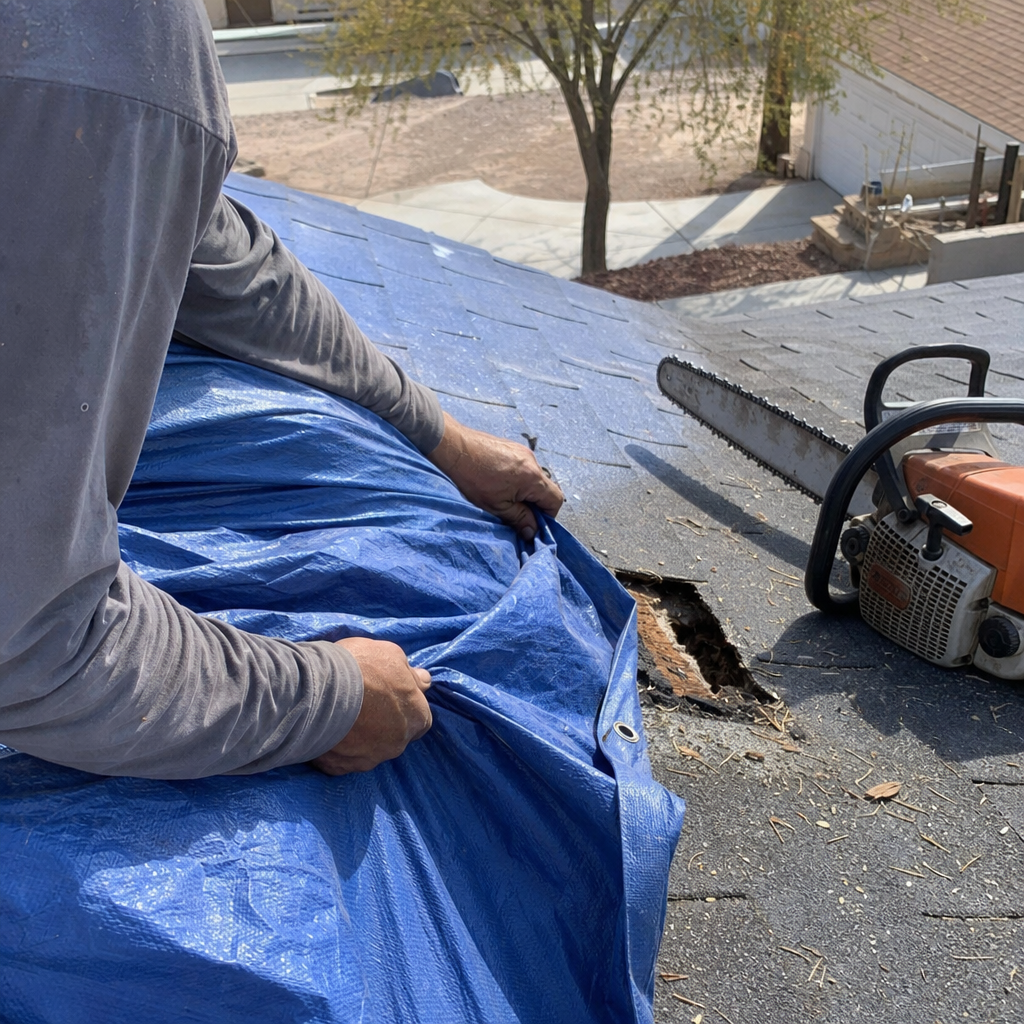
An emergency tarp is the difference between a manageable repair and a ruined ceiling, water-damaged walls, and mold. After a fast-moving July monsoon cell dropped nearly a half-inch on the Buffalo Ranch corridor in under 20 minutes, our crew reached a West Flamingo Road ranch-style home to find standing water pooled six inches deep on the rear modified-bitumen flat section, with the tile-to-flat transition flashing buckled and a seam blown open at the patio-cover junction — a textbook 89103 failure. We installed an emergency polyethylene tarp rated for 150°F surface temperatures over the compromised flat section that evening, then returned the following morning to document the failed lapped-seam joint and cracked mortar ridgecap tiles for a full storm damage repair and insurance claim package. Speed matters, but so does the quality of the tarp installation itself — a poorly secured tarp in a Spring Valley summer wind event is its own emergency.

Insurance Claims Assistance
Navigating an insurance claim after spring Valley storm damage is genuinely confusing, especially when the damage involves both tile sections and flat membrane sections on the same roof — adjusters sometimes want to separate them into two claims, which can slow your payout. William walks through the damage documentation with you, provides detailed photo evidence and written scope-of-loss reports, and works directly with your adjuster so the repair scope reflects what actually failed, not just what’s visually obvious. We’ve processed storm claims in Spring Valley’s 89103 zip code repeatedly, including cases where HOA-mandated tile profile matching added legitimate material costs that needed to appear accurately in the claim.

Wind Damage Repair
Spring Valley sits in a corridor that channels wind off the Spring Mountains through the West Flamingo Road and Bruce Woodbury Beltway zones, and it shows in the wind damage patterns we see on tile roofs: displaced cap tiles, lifted field tiles, and — on older 1980s homes — fastener pull-through on aging wood decking that’s been cycling through extreme heat and dryness for three decades. We reseat and re-mortar cap tiles, replace cracked field tile with profile-matched stock, and inspect the underlayment beneath any lifted section, because wind that got under a tile almost certainly disturbed the layer below it as well.

What happens when you call
- 1
A real person answersNo phone trees — you reach a local pro.
- 2
You get an upfront price rangeHonest numbers before anyone is dispatched.
- 3
A background-checked tech heads outLicensed & insured, dispatched right away.
- 4
You approve before work beginsNothing starts until you say go.
Trusted Brands We Service in Spring Valley
We carry active inventory across seven manufacturer lines — GAF, CertainTeed, Owens Corning, IKO, Atlas, Tamko, and Boral — and that breadth matters specifically in Spring Valley, where HOA profile-matching requirements for Boral and equivalent concrete tile molds from the 1980s and 1990s can stall a repair if a crew doesn’t already have the material staged. Our recommendation is always driven by what fits the roof structurally and aesthetically, not by what we have too much of. For Spring Valley customers, that means faster turnarounds on both emergency installs and planned replacements.
Common Emergency & Storm Damage Problems We See in Spring Valley Homes
- Monsoon overload on clogged flat-roof drains: The 1980s and 1990s rear additions and patio covers on Spring Valley ranch homes were built with undersized or minimal drainage, and decades of desert dust accumulation compound the problem. When a monsoon delivers a half-inch of rain in 20 minutes, those flat sections pond immediately — and the built-up or modified-bitumen membrane underneath, already embrittled by years of 150°F surface heat, fails at seams and lap joints that looked sealed until they weren’t.
- Tile-to-flat transition flashing failures: Original metal flashings at the junction between pitched tile sections and flat rear additions have been oxidizing in Spring Valley’s alkaline desert air since these homes were built. A single hard-rain event drives water beneath cracked mortar ridgecaps and through those compromised flashings into the wood decking below — and by the time a homeowner sees a ceiling stain, the decking is already wet.
- HOA profile-matching delays after tile damage: In Canyon Gate and along the Buffalo Drive corridors, HOA covenants require storm-damaged concrete tile replacements to match discontinued 1980s and 1990s profile geometries and color blends. Roofers who show up without pre-sourced legacy inventory face HOA rejection and must re-order, leaving the damaged section exposed for days or weeks longer than necessary. This is a Spring Valley-specific constraint that doesn’t apply to comparable Henderson or North Las Vegas neighborhoods from the same era.
- Mortar ridgecap displacement during wind events: The original mortar used to set ridgecap tiles on Spring Valley homes from this era has exceeded its service life in most cases — it’s chalky, cracked, and barely bonded. A monsoon wind gust doesn’t need to be exceptional to send a ridgecap tile off the roof. Once a cap tile is displaced, the field tiles beneath it are exposed to any follow-on rain, and the damage escalates quickly from a $400 cap-tile reset to a $1,200+ underlayment repair if the timing is bad.
The 89103 Housing Stock Problem No Other Page Explains
Spring Valley’s 89103 zip code has a roofing challenge that’s specific enough that crews unfamiliar with the neighborhood regularly get it wrong. The bulk of the residential stock here dates from the late 1970s through early 1990s — ranch-style homes and garden-style apartments with two distinct roof planes: pitched concrete or clay tile over wood decking on the main structure, and built-up or modified-bitumen flat membrane on rear additions, patio covers, and accessory structures. Those two systems were designed and installed as separate products, and they age at different rates under the same brutal Mojave sun. The flat sections bake to brittleness year-round under rooftop surface temperatures exceeding 150°F, while the tile sections oxidize their mortar ridgecaps and original metal flashings in the alkaline desert air. The Las Vegas Valley averages under 4.5 inches of rain per year — so both failure modes accumulate invisibly, with no rainfall to probe the weak points. Then the July–September monsoon window arrives. Six weeks of fast-moving, intense storms suddenly stress every compromised seam, every oxidized flashing, and every cracked mortar joint at once. That’s the Spring Valley emergency pattern. It’s predictable in hindsight, devastating when it hits, and it requires a roofer who knows both membrane repair and legacy tile sourcing — not one or the other.
The Canyon Gate community and adjacent HOA corridors along West Flamingo Road and Buffalo Drive add another layer: concrete tile replacements must match discontinued 1980s and 1990s profile geometries and color blends. A roofer who arrives without pre-inventoried legacy tile — including discontinued Boral molds — will face HOA rejection on the replacement work and leave storm-damaged sections exposed while waiting on a re-order. We’ve built our Spring Valley inventory specifically around this constraint, and it’s the reason we resolved the Canyon Gate tile match on that West Flamingo Road home without delaying the repair timeline by a single day.
Pricing for Emergency & Storm Damage in Spring Valley, NV
Here’s what actual Spring Valley emergency and storm damage work typically runs in the current market:
- Emergency tarp installation: $350–$650, depending on roof size and access. Same-day availability.
- Flat-roof seam repair (modified-bitumen or built-up): $450–$900 for isolated seam and lap-joint failures on rear additions and patio covers.
- Tile-to-flat transition flashing replacement: $600–$1,400, reflecting both the flashing material and the mortar ridgecap work typically required at the same time.
- Mortar ridgecap reset and tile replacement (per section): $300–$750 for standard profiles; legacy HOA profile-match tile can add $150–$400 in material sourcing cost depending on availability.
- Full storm damage repair with insurance documentation: $1,200–$4,500+, depending on the extent of membrane, decking, flashing, and tile damage across both roof planes.
These are Spring Valley market figures for 2024–2025. What moves the number most is whether the wood decking below the membrane has taken on moisture — that’s the variable we assess on-site. Call (725) 444-5513 for a free on-site estimate; William reviews every job personally before we quote it.
We Also Serve Cities Near Spring Valley
Absolute Roofing & Repair Las Vegas covers the full southwest metro, including emergency and storm damage response in Paradise to the east, Summerlin South to the northwest, and Enterprise to the south. If you’re just outside Spring Valley’s 89103 zip, call us — response time across these neighboring communities is comparable, and the same owner-led service applies regardless of which side of the city line you’re on.
Serving Spring Valley, NV — Our Local Coverage Area
We’re based in the Spring Valley area and know this community well. Use the map below to see our service coverage — if you’re nearby, we can almost certainly help.
FAQs — Emergency & Storm Damage in Spring Valley
They fail suddenly because the Mojave’s under-4.5-inches-per-year rainfall means the underlying damage — UV embrittlement, seam separation, oxidized flashings — accumulates without any rain probing the weak points. The built-up and modified-bitumen membranes on Spring Valley’s 1980s–90s rear additions bake at surface temperatures above 150°F for months, and the material becomes brittle at seams and lap joints where flexibility is most critical. When monsoon rain finally arrives, it hits every compromised point simultaneously and with intensity — a half-inch in under 20 minutes is not unusual in the Buffalo Ranch and West Flamingo corridors. The roof didn’t fail suddenly; it just reached its limit the moment it was actually tested. Call (725) 444-5513 if you’re seeing signs of water entry — early is always cheaper than late.
Technically, yes — but your HOA’s profile-matching requirement means that not every roofer can replace them correctly. Canyon Gate and the adjacent HOA corridors along West Flamingo Road and Buffalo Drive require replacement tiles to match the original 1980s and 1990s profile geometries and color blends, many of which come from discontinued Boral and equivalent molds. A roofer who doesn’t carry legacy tile inventory will install what’s available, get flagged by the HOA, and then you’re waiting on a re-order with the damaged section still exposed. We maintain pre-sourced legacy profile stock for exactly this reason. Call us at (725) 444-5513 before you commit to any contractor on a Canyon Gate tile repair.
As fast as possible — ideally the same evening. Modified-bitumen and built-up membrane sections that have been opened by a storm will absorb moisture into the wood decking within the first 24 hours in any standing-water situation, and once the decking is wet, the repair scope and cost grow significantly. A surface temperature of 150°F will dry standing water fast once the sun returns, but the damage to the decking happens before the drying. Emergency tarps in Spring Valley typically run $350–$650 depending on roof area and access. Call (725) 444-5513 the same day the storm hits — we stage emergency tarp installations for same-day response.
Most standard homeowner’s policies in Nevada cover storm-caused damage to flashings and roofing systems, including tile-to-flat transition failures triggered by a qualifying weather event — but the documentation has to establish that the failure was storm-caused, not pre-existing maintenance neglect. This is where the line gets contested. Oxidized flashings that finally failed during a storm are sometimes characterized by adjusters as wear-and-tear rather than storm damage. We document the failure point, the storm timeline, and the condition of surrounding materials in a way that supports the storm-cause argument. William handles the documentation walk-through personally. Call (725) 444-5513 before you file — we’ll help you understand what the claim should cover before the adjuster sets the narrative.
Wind is far more likely than hail to drive emergency calls in Spring Valley. The Las Vegas Valley does see occasional hail — small-diameter, typically — but the monsoon wind events that push through the West Flamingo Road and Bruce Woodbury Beltway corridors are the consistent culprit. On Spring Valley’s aging tile roofs, wind dislodges mortar ridgecaps that have already exceeded their service life, and once a cap tile is gone, field tiles lift and the underlayment is exposed to any follow-on rain. Hail damage does happen and is worth inspecting after any storm event, but if you’re deciding what to worry about first, wind on a 30-year-old tile roof is the primary emergency risk in this zip code. Call (725) 444-5513 after any significant storm — the inspection is free and the findings are honest.
Reviewed by William Turner, Owner & Lead Technician at Absolute Roofing & Repair Las Vegas, serving Spring Valley and the greater Las Vegas Valley for 10 years.